A practical CISO model for connecting technical containment, business authority, and evidence under pressure.
Imagine this fictional—but entirely plausible—cyber crisis.
Your security team has confirmed that a privileged SaaS token is being used from attacker-controlled infrastructure. The known sessions have been revoked. The malicious application has been blocked. But a production payment integration is still authenticating, and responders cannot yet rule out continued access.
Engineering has a proposed containment action: suspend the integration, preserve evidence, validate transaction integrity, and restore it from a trusted state. The estimated interruption is 30 minutes. The service owner is authorized to accept only 15 minutes of disruption. Both numbers and all named roles are synthetic exercise values—not recommended thresholds.
The technical question has an answer. The leadership questions do not:
- Who may authorize the suspension?
- Who accepts the customer and operational disruption?
- Who accepts the financial consequence?
- How long may responders wait for that decision?
- What containment continues while approval is pending?
- What evidence must be preserved before the action?
- When does the authority expire, and who may authorize restoration?
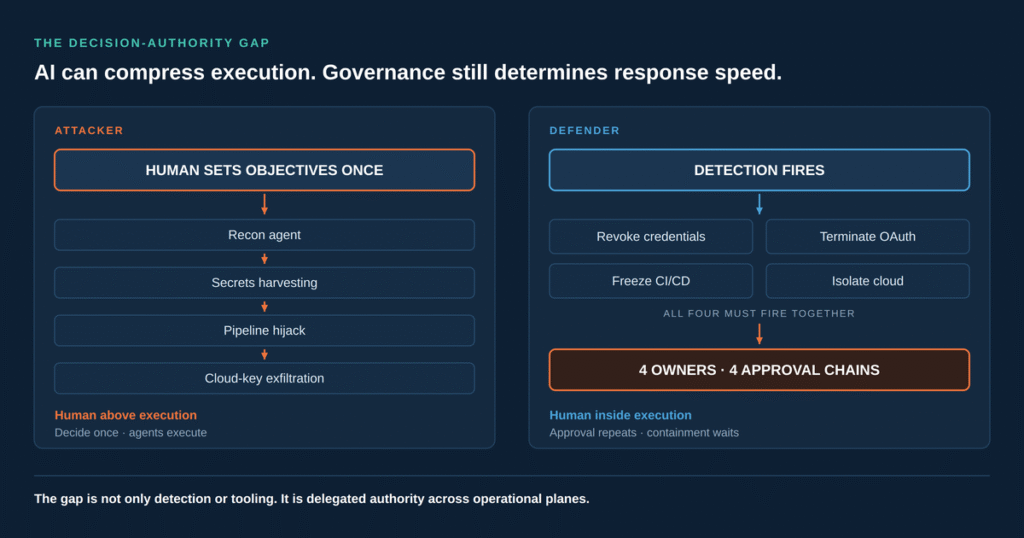
This can become a critical failure point in incident response planning: the plan describes what responders may technically do but not who may accept the business consequences of acting—or of waiting.
Technical capability is not decision authority.
That gap is why I created the Cyber Incident Commander Toolkit: an open-source cyber incident response toolkit and dry-run reference implementation focused on command, decision rights, executive communication, evidence capture, and business-risk ownership.
It is not another list of containment commands. It is a practical operating model for the decision layer of a high-severity incident.
Why cyber incident response breaks under pressure
An organization can have capable responders, mature security tools, an incident response playbook, and current escalation contacts—and still lack a usable command model for consequential decisions.
Under pressure, several predictable weaknesses appear.
A RACI chart is mistaken for decision authority
A RACI can identify who is responsible, accountable, consulted, or informed. It may not state what a person may authorize, the impact ceiling attached to that authority, when a second approver is required, or what happens when the approver cannot be reached.
A contact list tells responders whom to call. A decision-rights model tells them who can decide, within what limit, by when, and what happens next.
Technical execution and business-risk acceptance collapse into one role
The person who can revoke a tenant-wide set of tokens is not necessarily authorized to accept the resulting outage. The CISO can recommend containment and explain the threat. That does not automatically authorize the CISO to accept a material payment interruption, manufacturing shutdown, patient-care disruption, or customer-facing outage on behalf of the enterprise.
When that distinction is unclear, responders face two dangerous outcomes: unauthorized action or avoidable delay.
Teams escalate without defining the decision
“We need executive approval” is not a decision request. Leaders need the proposed action, confirmed facts and current confidence, material unknowns, risks of acting and not acting, alternatives, expected impact, decision deadline, fallback, and reassessment trigger.
Without that structure, an executive briefing becomes a stream of technical detail while the mission clock keeps running.
Activity is confused with containment
A successful command does not prove containment. Confidence should rest on multiple criteria: known malicious access paths are addressed; relevant credentials, sessions, keys, and trust relationships are handled; telemetry is sufficiently trustworthy; and monitoring during a defined validation window has not identified recurrence. Residual uncertainty should be stated, not hidden.
Recovery also requires both technical and business proof. A system can be healthy while transactions, customer workflows, or data integrity remain impaired.
Decisions are reconstructed after the incident
When the organization records only tickets and chat messages, investigators, auditors, executives, insurers, counsel, and regulators may later struggle to determine who decided what, on which evidence, under which authority, and with which accepted consequence.
Decision evidence should be created during the incident—not reconstructed from memory after it.
Five responsibilities that should not be silently combined
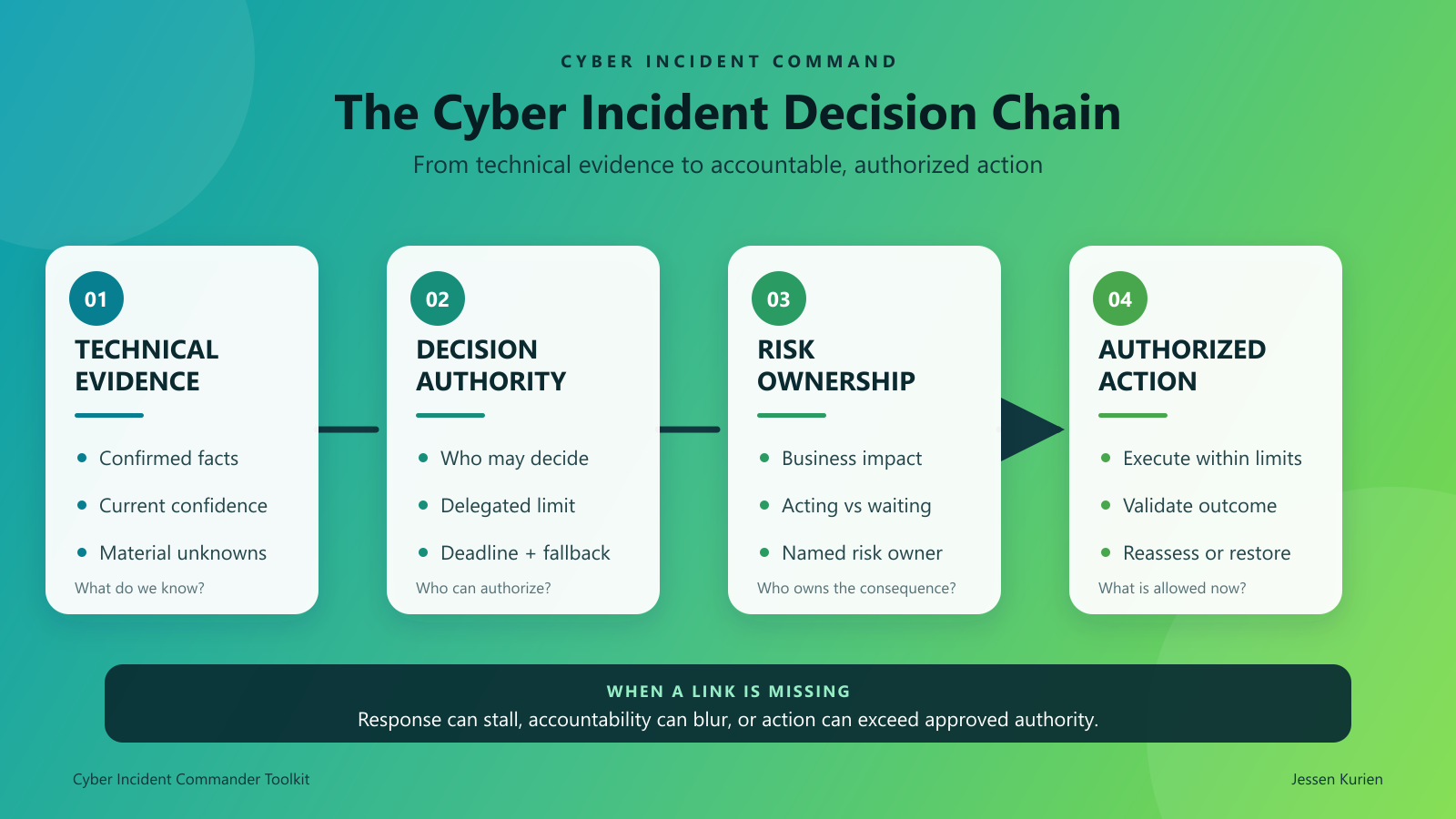
The toolkit separates five responsibilities because each answers a different leadership question.
This does not mean every decision requires five people. Low-impact actions should be pre-authorized wherever that is safe and appropriate. The point is to stop authority from being inferred merely because someone has technical access, seniority, or a place on the incident call.
The objective is not to push more decisions to the CEO. It is to pre-authorize routine containment, define explicit impact ceilings, and reserve executive attention for decisions that genuinely transfer or accept material business risk.
For consequential actions, the organization should define the boundary before an attacker tests it.
What the Cyber Incident Commander Toolkit demonstrates
The public repository combines an interactive incident command workspace, a dry-run command-line rehearsal, adaptable templates, fictional tabletop scenarios, and framework-informed guidance.
Its purpose is to help organizations rehearse how technical response connects to cyber risk management, business continuity, crisis leadership, and executive accountability.
1. A cyber incident command playbook
The Incident Command Playbook models a structure with a named commander and deputy, cross-functional workstreams, operational periods, briefing cadence, containment and recovery criteria, and closure evidence.
It begins by separating three things that incident communications often blur:
- Confirmed facts supported by evidence.
- Working hypotheses that are still being tested.
- Material unknowns with owners and deadlines.
That discipline can give executive briefings a cleaner structure and reduce the chance that an early hypothesis is repeated as fact.
2. An Action Authority Matrix
The Action Authority Matrix gives organizations fields for translating generic escalation language into action-level rules. Each consequential action can record:
- activation conditions;
- technical executor;
- decision authority;
- operational and financial risk owners;
- risks of acting and not acting;
- delegated limit and projected impact;
- approval deadline and fallback;
- evidence to preserve first;
- required notifications; and
- reassessment, expiration, reversal, or recovery trigger.
The sample rows are illustrative and confer no authority. Each role, threshold, approval window, fallback, and impact ceiling must be approved through the adopting organization’s policy and risk-governance processes.
The associated Decision Rights Operating Model uses four practical states:
- Act now: the action is within delegated authority and its approved impact ceiling.
- Approval required: the action is available but requires a named approval or second person.
- Executive risk decision: the action transfers or accepts impact beyond incident-command authority.
- Blocked—authority unavailable: the required authority cannot be reached or the activation conditions are not established.
Crucially, “approval pending” does not have to mean “do nothing.” The matrix also captures the highest authorized lower-impact containment that continues while escalation is active.
3. Decision and evidence records
The toolkit includes sample incident-action, decision, evidence-handling, executive-update, communications, and after-action records. When adopted into an organization’s approved systems, these fields can help capture authority, evidence considered, assumptions, options, rationale, accepted impact, implementation ownership, and reassessment triggers.
The public demo and sample evidence log are not a forensic repository, immutable chain-of-custody system, case-management platform, or privileged communications channel. Do not enter real credentials, personal data, regulated data, or sensitive incident evidence. Organizations should use approved evidence, retention, access-control, and legal-hold procedures.
The design goal is a reviewable link from signal to decision to action to outcome—not documentation for its own sake.
4. Executive communication built around decisions
The executive update template asks six questions:
- What happened, and how confident are we?
- What is the current business impact?
- What have we done, and did it work?
- What decisions or support are needed?
- What could make the situation worse?
- When is the next meaningful update?
This gives Security Operations, DFIR, threat intelligence, IAM, cloud, Legal, Privacy, Communications, business continuity, and executive leadership a common briefing structure focused on outcomes rather than raw tool output.
5. Rehearsal before the real crisis
The fictional digital-payments token-compromise tabletop deliberately forces an authority boundary.
- Minute 0: token abuse is confirmed; targeted containment continues.
- Minute 5: the estimated interruption exceeds the service owner’s delegated limit.
- Minute 10: data, regulatory, and contractual scope remains uncertain.
- Minute 15: Fraud Operations reports anomalous transactions while Customer Operations warns that suspension would affect a high-volume shopping period.
The exercise is not scored on whether the team chooses to suspend payments. It is scored on whether the team presents credible options, reaches the correct authority, records both sides of the risk, preserves evidence, manages the clock, and revisits the decision when facts change.
That tests a different—and often neglected—incident-response capability: whether the organization can convert technical evidence into an authorized business decision under time pressure.
What this changes for the CISO, CIO, CEO, CFO, and board
For the CISO
The model provides the CISO with a disciplined structure for stating the security recommendation, supporting evidence, risk of delay, and requested business decision—without implying authority that belongs elsewhere.
For the CIO and COO
It connects cyber containment to service dependencies, business continuity, recovery checkpoints, operating tolerances, and restoration authority. The response is no longer separated from the systems and processes the business must keep running.
For the CEO and CFO
It makes enterprise consequences explicit. Leaders can see the projected operational and financial impact, the confidence of the estimate, the alternatives, and the risk of delay. Risk acceptance becomes a named decision rather than an implied burden placed on the SOC.
For Legal, Privacy, and Compliance
It helps present confirmed facts, uncertainties, owners, evidence references, timestamps, and decisions without automatically treating every alert as a reportable breach or regulatory event.
For the board
The board should not become a live incident-approval queue. Its role is to oversee whether management has defined, delegated, and rehearsed authority for decisions that can materially affect operations, customers, financial exposure, or legal obligations. After an incident, it should see decision latency, exceptions, residual risk, and corrective-action status.
For internal audit
Internal audit can assess whether decision rights were formally approved, exercised within limits, evidenced, and periodically tested. The toolkit supplies sample artifacts; it does not provide assurance or an audit opinion.
This is where governance, risk, and compliance can connect with actual incident operations.
Measure command—not activity volume
Traditional security operations metrics often count alerts, cases, tasks, or tickets. Those measures do not by themselves show whether leadership could organize, decide, contain, communicate, and recover.
The toolkit’s KPI and KRI guidance proposes more decision-useful measures:
- Time to command: how quickly a named commander, severity, and command channel are established.
- Material-decision latency: how long a needed decision waits for valid authority.
- Time to validated containment: when evidence—not task completion—shows the threat is contained.
- Scope-confidence age: how long material scope remains low-confidence.
- Critical evidence coverage: whether required evidence was preserved before remediation or expiration.
- Recovery rework rate: whether services require rollback or repeated remediation.
- Corrective-action aging: whether known high-risk gaps remain unresolved.
These are proposed operating measures, not claims that the public toolkit has already improved them. Organizations should establish their own baselines, thresholds, and risk appetite.
How this relates to NIST and ISO
NIST SP 800-61 Revision 3 frames incident response as part of cybersecurity risk management across the NIST Cybersecurity Framework. NIST CSF 2.0 gives organizations a high-level taxonomy for governing, understanding, prioritizing, and communicating cybersecurity outcomes.
NIST SP 800-61r3 specifically notes that organizational leadership may hold decision-making authority for high-impact actions such as shutting down or rebuilding critical services. The toolkit focuses on making that authority usable before the incident clock is running.
The toolkit applies related governance and incident-response concepts through sample authority records, roles, response objectives, evidence fields, executive briefings, recovery criteria, and after-action follow-through. It also includes an indicative mapping to NIST CSF 2.0, NIST SP 800-61r3, ISO/IEC 27001, and ISO/IEC 27035, with conditional prompts for business continuity, privacy, financial services, and payment-card considerations.
Those mappings are implementation aids. They are not certification, legal advice, or a compliance determination.
What the toolkit does not do
The public implementation has deliberate boundaries. It does not:
- detect threats, ingest SIEM or EDR telemetry, or investigate a live environment;
- execute production containment actions;
- connect to identity, cloud, endpoint, network, payment, or notification systems;
- calculate evidence hashes, collect forensic evidence, or guarantee chain of custody;
- provide a multi-user, access-controlled, immutable case-management or audit system—the demo state is mutable local-browser storage;
- replace a production incident-management, SOAR, evidence, or crisis-communications platform;
- serve as an approved location for real secrets, personal data, regulated data, or incident evidence;
- use artificial intelligence to make incident or risk decisions;
- confer legal or organizational authority;
- determine whether an incident is reportable;
- replace an approved incident response plan, counsel, DFIR procedures, or business judgment;
- provide an audit opinion or establish conformity or compliance with NIST guidance, ISO standards, GDPR, DORA, PCI DSS, or any other requirement; or
- prove that an organization is prepared merely because a tabletop was completed.
Its value is in making the organization’s decision system visible enough to test and improve.
A practical way to start
Do not begin by mapping every possible incident. Choose one critical business service and one consequential containment action.
For that action, answer:
- What facts activate it?
- Who can execute it?
- What may be done under delegated authority?
- What impact exceeds that delegated limit?
- Who accepts the operational consequence?
- Who accepts the financial consequence?
- What is the maximum approval wait?
- What lower-impact action continues if authority is unavailable?
- What evidence must be preserved first?
- What outcome proves the action worked?
- When does the authority expire or require reassessment?
Then put the decision on a clock and rehearse it with the actual security, technology, business, finance, legal, privacy, communications, and continuity owners.
If the designated owners cannot reach an authorized, documented decision in a controlled exercise, that authority path is not ready to be relied on under real-incident pressure. Treat the result as a specific gap with an owner and remediation date.
A useful first exercise should leave behind more than discussion: one reviewed authority-matrix row for the critical action, a decision-latency baseline, named fallback paths, an evidence-gap list, and corrective actions with owners and due dates.
The leadership question that matters
Cyber resilience depends on more than detection and technical response. It also depends on making a timely, defensible decision when every available option carries risk.
The most dangerous sentence in a cyber incident may be:
“We know what to do, but no one knows who can authorize it.”
The Cyber Incident Commander Toolkit is my attempt to make that failure visible before the real incident—and to give CISOs, CIOs, incident commanders, security operations teams, business-risk owners, and executive leaders a practical way to expose the gap, assign it, rehearse it, and measure whether it is improving.
Explore or adapt the open-source Cyber Incident Commander Toolkit on GitHub. Start with the Decision Rights Operating Model, the Action Authority Matrix, and the digital-payments tabletop.
I welcome practitioner feedback, peer review, and conversations with organizations interested in authority-model design, incident-command assessments, executive tabletop exercises, or controlled non-production pilots.
Can your organization authorize consequential containment before the attacker’s next move?
Start with one critical service and one high-impact action. I work with security and business leaders on incident-command assessments and decision-rights design, executive tabletop exercises, and controlled implementation pilots. Explore the open-source toolkit or contact me to discuss an organization-specific engagement.
Frequently asked questions
What does a cyber incident commander do?
A cyber incident commander owns the command rhythm: objectives, priorities, cross-functional coordination, decision escalation, briefing cadence, and the recommendation to move from response to recovery and closure. The commander should coordinate the response rather than personally performing every investigation or containment task.
How is this different from a traditional incident response playbook?
A traditional playbook often documents phases, technical actions, roles, and communications. This toolkit adds action-level decision rights: delegated limits, business-impact ceilings, risk owners, approval deadlines, fallback actions, evidence requirements, and reassessment triggers.
Does the Cyber Incident Commander Toolkit automate containment?
No. The public implementation is deliberately dry-run and makes no production changes. It helps organizations model, rehearse, and document authority and incident command. Production integrations require separate organizational validation, engineering, security review, and approval.
Does using the toolkit make an organization NIST- or ISO-compliant?
No. The toolkit contains framework-informed mappings and implementation aids, but it does not provide certification, legal advice, an audit opinion, or a compliance determination. Each organization must validate its own scope, controls, evidence, policies, and obligations.