Only 28% of organizations can reliably trace an agent’s actions back to a human or system. Everything else in AI agent security follows from that number.
A security operations center can usually answer three questions about an employee. Who are they? What are they allowed to access? What did they do?
Ask the same three questions about an autonomous AI agent and the answers get soft.
The agent may authenticate through a service principal, inherit a user’s delegated access, call several tools through APIs or Model Context Protocol servers, spawn sub-agents, write to memory, retrieve sensitive data, and take actions across cloud, SaaS, identity, code, and business systems. That activity lands in a dozen different logs with no durable identifier connecting the sequence.
That is the blind spot in the AI-enabled SOC. And it is not a model problem.
Consider a SOC that automated its own triage
This pattern is becoming common enough to be worth walking through.
A security team deploys an investigation agent. It queries the SIEM, isolates endpoints through EDR, disables accounts in the identity provider, updates ServiceNow tickets, and executes cloud remediation runbooks. Every one of those permissions was requested, reviewed, and approved. Each is defensible on its own. Together they are the reason the agent is useful: it can close the loop from alert to containment without waiting for a human.
As part of triage, the agent reads a shared mailbox. One morning it processes a message crafted to look like an internal escalation notice—a widening compromise, a list of affected hosts, an instruction to contain immediately. The agent is pursuing an objective it was given: contain the incident. It treats the retrieved content as context, expands its target list, and begins isolating hosts and disabling accounts.
Every action authenticates correctly. Every action falls inside granted permissions. No policy is violated. Nothing in any individual log looks anomalous, because nothing in any individual log is anomalous.
By the time an analyst notices, forty production hosts are isolated and a dozen accounts are disabled.
No control failed. Every permission was approved. The agent did exactly what it was authorized to do. Prompt injection was the entry point, but the damage was done by legitimate authority, exercised at machine speed, through tools a review board had already signed off.
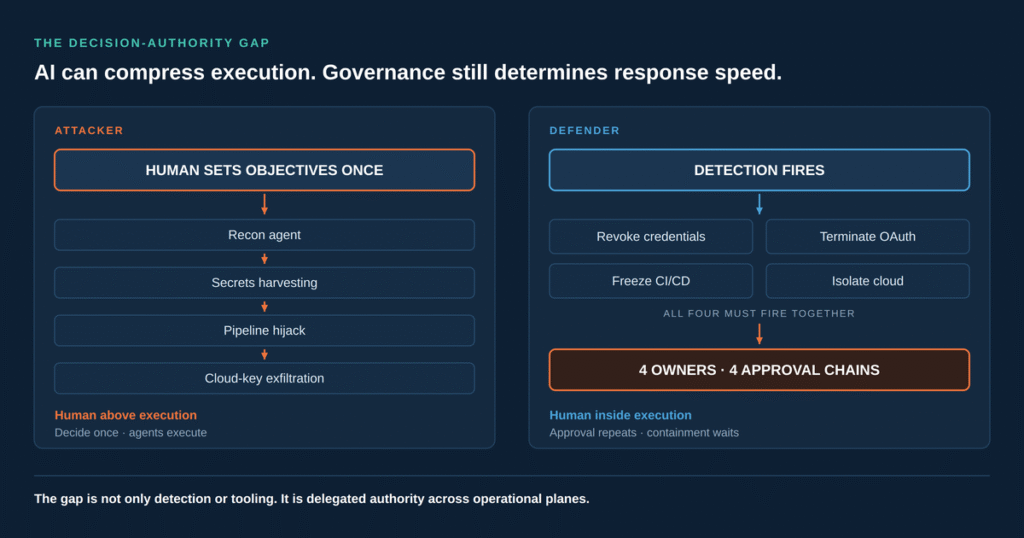
A human analyst doing the same thing gets stopped somewhere around host three—a colleague sees it, a change window blocks it, or the analyst hesitates. An agent completes the full sequence before anyone opens the ticket. The asymmetry is not that agents make worse decisions. It is that they finish.
The gap is measurable
The Cloud Security Alliance surveyed 285 IT and security professionals in September and October 2025, publishing the results in February 2026 in research commissioned by Strata Identity. Three findings define the problem:
21% maintain a real-time registry or inventory of their agents. 18% are highly confident their IAM systems can manage agent identities effectively. Only 28% can reliably trace agent actions to a human or system across all environments.
That last number is the one that matters. It is the difference between an incident and an investigation.
The same survey found that 44% use or plan to use static API keys to authenticate agents, and 43% use username and password combinations—long-lived, frequently shared secrets issued to identities that act on their own.
NIST’s National Cybersecurity Center of Excellence published a concept paper in February 2026 on Software and AI Agent Identity and Authorization and is reviewing comments on it. The initiative explores standards-based approaches to identify, manage, and authorize the access and actions taken by software agents, including AI agents. The scale and range of agent actions can increase exponentially; identity is the control plane that must absorb that growth.
Can the organization identify every agent, reconstruct what it attempted, determine which authority it used, contain that authority quickly, and prove the result?
If the SOC cannot do that, the organization has deployed autonomy without deploying the accountability that should accompany it.
An AI agent identity is more than a credential
One source of confusion is treating the API key, token, certificate, workload identity, or service account as the agent itself.
The identity subject and the authentication mechanism are different objects. An agent may use several credentials during a single task. A credential may be shared by several workloads, which makes attribution weak even when authentication succeeds perfectly. This is the gap the Cloud Security Alliance’s definition of non-human identity is built to close: it separates the digital identity from the credential used to authenticate it and identifies familiar enterprise failure modes—missing ownership, excessive permissions, static secrets, weak lifecycle management, and limited visibility.
For each production agent, the organization needs a durable, maintained record that an access review, an exposure calculation, and an incident investigation can all read. At minimum, it should hold:
- A unique agent identifier and current version; its named human sponsor and technical owner; and its approved business purpose and risk tier.
- The human, workload, or delegated identity it operates under, plus credential type, issuer, audience, scope, expiration, and rotation owner.
- Every tool, API, MCP server, model, data source, and memory store it can reach.
- Permitted actions and explicitly prohibited actions.
- Its parent agent, child agents, and delegation path.
- Monitoring requirements, containment procedure, and retirement date.
Without that record, identity teams cannot run a meaningful access review, exposure teams cannot calculate blast radius, and analysts cannot connect an action to an accountable human.
An inventory answers what exists. An authority graph answers what can happen.
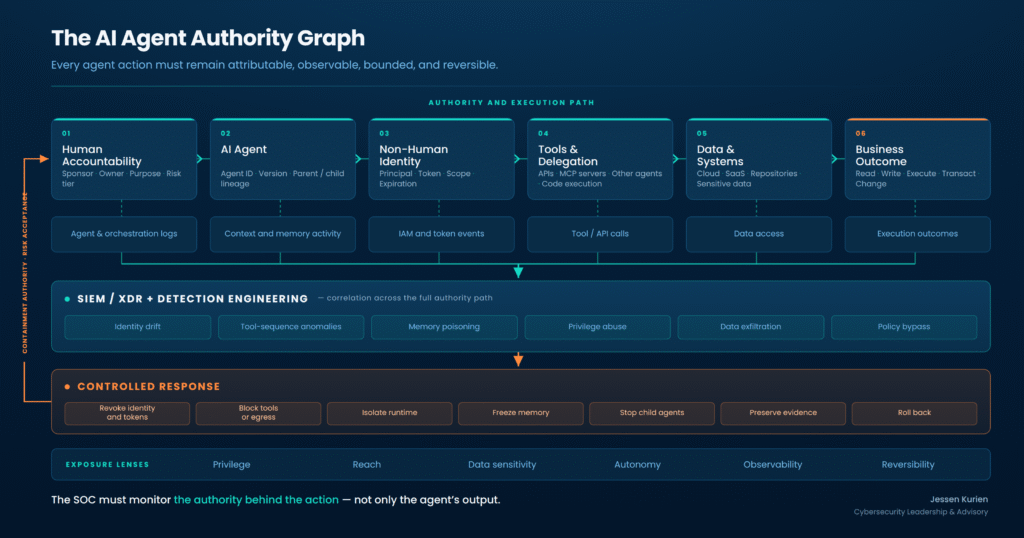
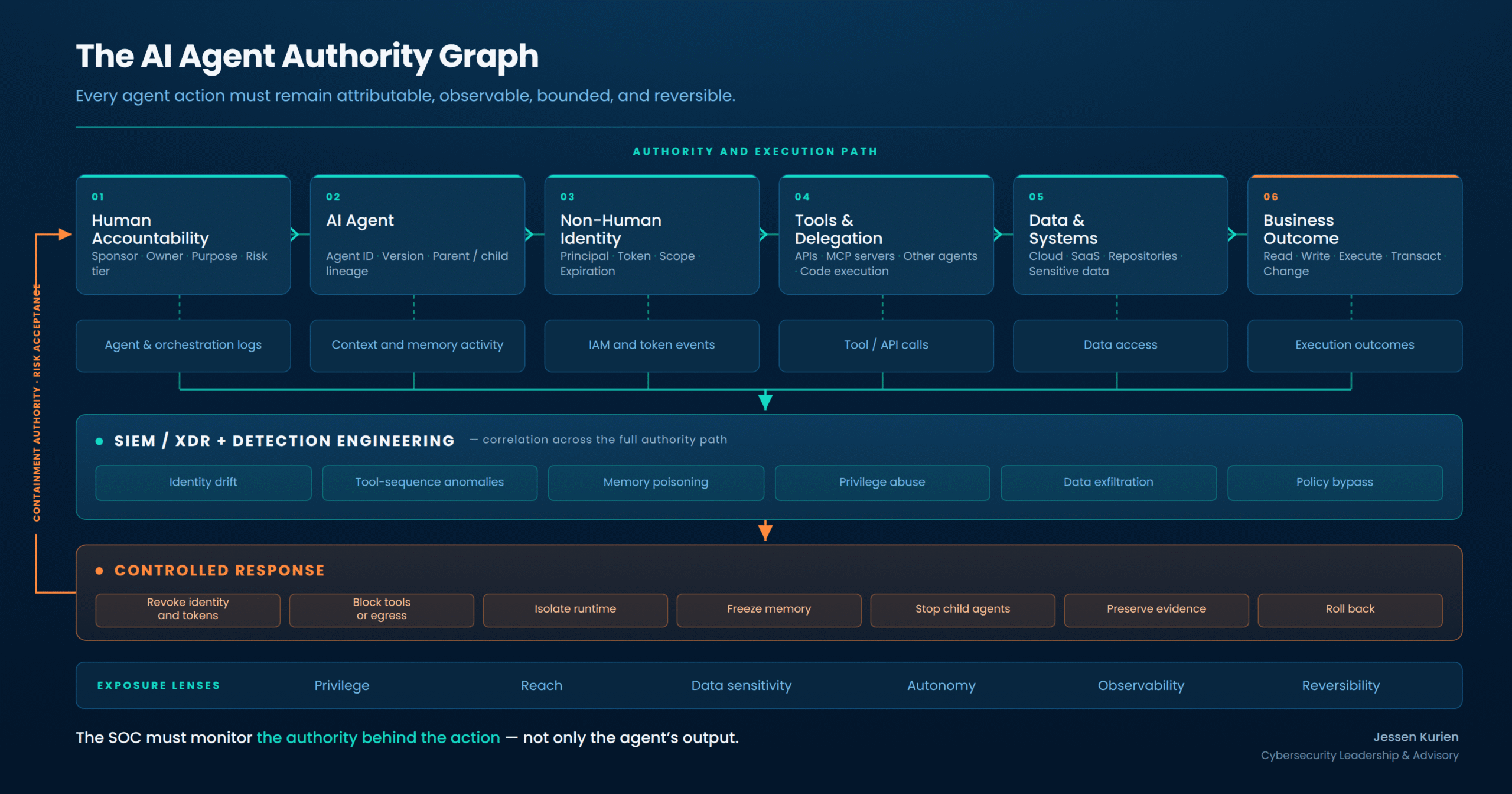
An inventory is a list. An authority graph is a set of relationships, and the risk lives in those relationships. For every production agent, map the chain: human accountability → agent → non-human identity → tools and delegation → data and systems → business outcome.
That path exposes combinations no individual control review catches. An agent has read access to a customer database. It can generate files. It can send email. Each permission is reasonable, each was approved by a different reviewer on a different day, and together they form an exfiltration path that appears nowhere in any single approval record.
The same logic applies with more force to agents operating inside security operations. The investigation agent above had SIEM access, EDR isolation rights, identity controls, ticketing integration, and cloud automation. That combination is exactly why it was valuable and exactly why it was dangerous.
This is where continuous threat exposure management earns its place. Rank agent exposure by the factors that change blast radius: privilege and reachable assets, sensitivity of accessible data, degree of autonomy, number and trust level of connected tools, reliance on static or shared credentials, and the ability to write code, alter configurations, or initiate transactions. Weight those against the defensive side—the quality of behavioral telemetry, the speed and reliability of containment, and whether the permitted actions can be reversed.
The highest-risk agent is rarely the one with the most permissions. It is often the agent with moderate privileges across several systems, weak attribution, persistent memory, and a kill switch nobody has tested.
Define the telemetry contract before production
Traditional IAM and cloud logs remain necessary. They rarely explain why an agent acted or how one action led to the next. An AI-enabled environment needs a telemetry contract that preserves the full decision and execution chain, agreed before the agent ships.
Agent and orchestration events establish who was acting
Capture agent ID, version, owner, purpose, risk tier, and environment; session, task, trace, and parent-child identifiers; the initiating human or upstream workload; delegation depth; and every agent-to-agent handoff. Without trace and lineage identifiers, an investigation cannot establish scope.
Identity and authorization events establish under what authority
Capture principal and credential ID; token issuer, audience, scope, and lifetime; requested versus granted permissions; just-in-time elevation and its approval reference; and the policy decision, policy version, reason, and enforcement point. Denied requests and fallback identities matter as much as successful ones—a blocked call retried through a second identity is a detection, not an error.
Model, context, and memory events establish what influenced the decision
Capture model and policy version; a prompt or context fingerprint rather than sensitive content; retrieved source identifiers and data classifications; memory read, write, update, and delete operations; and safety-control decisions and overrides. This class is often missing entirely, yet it explains goal hijacking after the fact.
Tool and execution events establish what was done
Capture tool or MCP server name, version, publisher, and integrity status; requested function, argument fingerprint, target resource, and action class; the tool-call sequence with response status, latency, retries, and side effects; plus conventional endpoint and cloud signals such as process creation, file activity, network connections, and control-plane changes.
Data and outcome events establish what changed
Capture data source, classification, query type, and volume accessed; egress destination and method; requested action versus executed action; resulting state and rollback identifier; and the associated incident, change, approval, or exception record.
None of this requires shipping every prompt and sensitive business value into the SIEM. Logging design should preserve security meaning while applying data minimization, access control, retention limits, and privacy requirements. An analyst should be able to move from a suspicious result back to the initiating objective, retrieved context, identity, policy decision, tool sequence, affected resource, and accountable owner. If a link in that chain is missing, the investigation stops there.
Detection engineering has to follow behavior across control planes
Signature detections will catch known indicators. Agentic systems also demand sequence, relationship, and behavioral analytics because the individual events may all be legitimate.
Twelve AI agent security use cases are worth building first:
- Identity or privilege drift: An agent gains a new role, scope, token audience, or data entitlement outside its approved baseline.
- Credential misuse: The same credential appears from an unexpected workload, network, geography, or runtime—or in concurrent sessions.
- Abnormal tool sequences: Individually permitted actions form a novel or high-risk chain: retrieval, compression, external upload, message deletion.
- Goal or context hijacking: The agent changes objective after reading untrusted email, documents, tickets, web content, code comments, or retrieved data.
- Memory poisoning: Persistent state is modified by an unexpected actor or workflow and later influences decisions.
- Unapproved agent creation: An agent spawns a child, mints a credential, or delegates work outside an approved lineage.
- Policy bypass: A blocked tool call is retried through another connector, identity, API, or agent.
- Sensitive-data path changes: A new classification, unusual volume, or destination conflicts with the agent’s purpose.
- Runaway execution: Rapid loops, repeated tool calls, escalating cost, or repeated failures indicate loss of control.
- Telemetry suppression: Logging, tracing, alerting, or policy enforcement is disabled or modified before a high-impact action.
- Human-approval anomalies: Approvals arrive unusually fast, outside the named role, in bulk, or after the action has started.
- Containment failure: Disabling the agent process does not revoke its identity, tokens, queued tasks, child agents, or active sessions.
These align with the OWASP Top 10 for Agentic Applications 2026: agent goal hijacking, tool misuse, identity and privilege abuse, agentic supply-chain vulnerabilities, unexpected code execution, memory and context poisoning, insecure inter-agent communication, cascading failures, human-agent trust exploitation, and rogue agents.
Building these detections requires telemetry from SIEM, XDR, EDR, identity, cloud, SaaS, API gateways, data security, model gateways, orchestration, MCP servers, memory stores, and the applications themselves. The objective is a coherent investigation timeline, not another collection of disconnected alerts.
Containment is a gradient
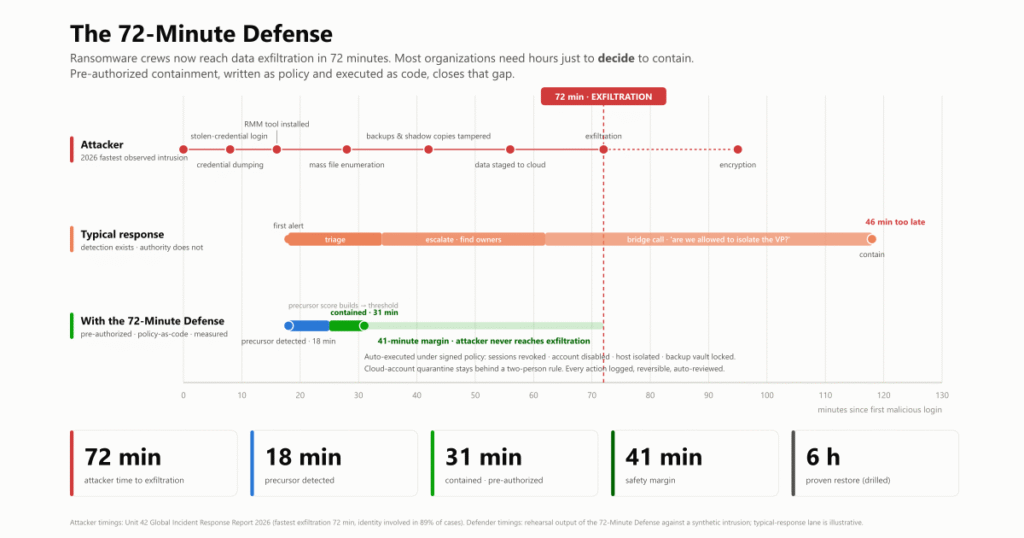
Pre-authorize narrow, reversible actions where evidence quality and blast radius are understood. Require stronger approval for anything touching privileged identities, production cloud accounts, CI/CD pipelines, customer data, financial systems, or several operational planes at once.
The more common failure is simpler: teams have one containment action—“turn it off”—and have never tested what that stops. A complete AI incident response plan distinguishes between:
- Stopping the agent process.
- Suspending its task queue.
- Disabling the agent identity.
- Revoking tokens and rotating credentials.
- Blocking specific tools or egress destinations.
- Isolating the runtime.
- Freezing memory and preserving evidence.
- Identifying and containing child agents.
- Reversing completed actions.
- Restoring service under newly issued authority.
Those are ten operations with ten failure modes. Killing a process does not contain the identity. Revoking one token does not remove a queued action. Disabling a parent agent does not guarantee its children stop.
Rehearse them before you need them. A kill switch that has never been tested is a documented assumption, not a control. The same operational discipline underpins pre-authorized containment in conventional incident response.
AI governance becomes real when it produces evidence
AI governance is operational only when policy produces observable controls, evidence, and corrective action. ISO/IEC 42001 sets requirements for establishing, implementing, maintaining, and continually improving an Artificial Intelligence Management System (AIMS), and it applies to organizations that develop, provide, or use AI systems.
For agent security, the AIMS and the SOC should read from the same records instead of maintaining parallel truths:
- The approved AI agent inventory and its ownership.
- AI risk and impact assessments.
- Identity, access, and segregation-of-duties decisions.
- Monitoring requirements and actual detection coverage.
- Containment test results.
- Exceptions, risk acceptance, and review dates.
- Corrective actions from incidents and exercises.
That connection strengthens governance without turning the SOC into an audit function. Security operations produces evidence about what agents actually did. The management system uses that evidence to judge whether controls still work and whether AI risk remains inside approved boundaries. Neither function can do its job on the other’s assertions.
The ten measures worth reporting
- Production agents registered with an accountable owner.
- Agent identities using short-lived, scoped credentials.
- Privileged agents holding standing access.
- Agents connected to sensitive data or high-impact tools.
- Agents with complete identity, tool, data, and outcome telemetry.
- Priority agent attack paths covered by tested detections.
- Mean time to identify the responsible agent, identity, and human sponsor.
- Mean time to constrain agent authority across all active sessions.
- Successful kill-switch and rollback tests.
- Overdue exceptions, unowned identities, and unsupported dependencies.
These show whether autonomy is governed in production. Counting policies written, training sessions delivered, or agents that passed a pre-deployment review does not.
Five questions for the next leadership meeting
- Can we name every agent that can write, execute, transact, or change production systems?
- Can we show the identity and effective permissions each agent uses at runtime?
- Can the SOC reconstruct an agent’s complete action chain across identities, tools, data, memory, and other agents?
- Can we constrain an agent’s authority quickly without destroying the evidence needed to investigate?
- Who has the authority to stop it, accept the residual risk, and approve its return to service?
If the answers are uncertain, that uncertainty is the finding.
The point
AI agents increase the speed and scale of security operations. They increase, by the same factor, the speed and scale at which legitimate authority can be misused. Organizations that capture the benefit will treat agent identity, exposure, detection, response, and governance as a single operating problem rather than five separate initiatives.
The AI-enabled SOC needs more than visibility into alerts. It needs a reliable account of who—or what—acted, under whose authority, against which resource, with what result, and whether that authority can be contained.
That is the foundation of accountable autonomy.
AI Agent Authority Reviews
I run fixed-scope reviews for organizations deploying autonomous AI agents into production. The engagement produces:
- A registry gap list naming unregistered or unowned production agents.
- An exposure-ranked inventory scored on privilege, reach, data sensitivity, autonomy, observability, and reversibility.
- A telemetry coverage map showing where the authority chain breaks and what it takes to close it.
- Tested containment procedures, including kill-switch and rollback results.